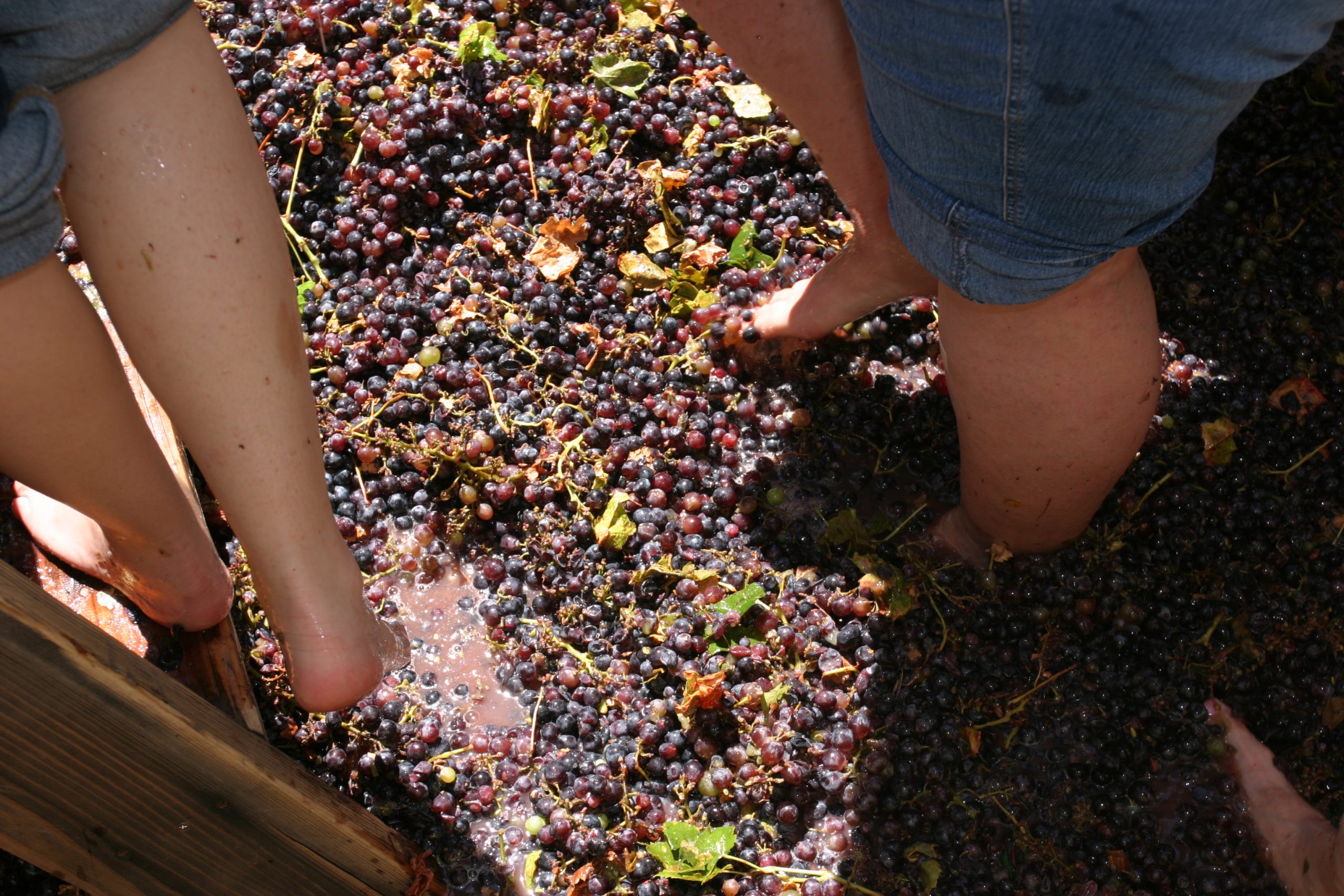
Crushing grapes with your feet is part of the procedures of traditional winemaking. Instead of being crushed in presses and grape crushers, the grapes were trodden in vats or grape-crushing basins, tanks intended for this purpose, barefoot or wearing special footwear, so that the berries would release their juice. Grape stomping lies at the heart of the history of winemaking. It still holds a significant place in the popular imagination, but with the introduction of industrial methods it has, in practice, remained mainly a curious recreational activity. It is sometimes revived during cultural events, village fairs and folk festivals.
Although it has now been relegated almost exclusively to a folkloric spectacle, grape stomping remains one of the most evocative images of the grape harvest and wine production.
One distinctive feature is the gentleness of crushing grapes with your feet, which does not cause the seeds to break. For this reason alone, grape stomping could be considered a method that is still valid, if not better, than roller crushing. Naturally, this method is suited to producing small quantities of wine, which will nevertheless stand out for its low acidity and low tannin content.
History of grape crushing
The origins of winemaking are rooted in prehistory and even in legend. Not even the word wine has a certain origin: many peoples and languages claim its genesis. The fact is that the Bible speaks of Noah being drunk, and characters drink wine in the Epic of Gilgamesh, which dates back more than 4,000 years. In Babylon, the Code of Hammurabi mentions wine, described as “beer of the mountains”.
However, the origins of wine most likely predate those of writing, just as winemaking predates the actual cultivation of vines. As early as the Palaeolithic period, the spontaneous fruits of wild vines were used to produce wine.
An ancient tradition
As for organised, purposeful grape crushing, in southern Armenia the oldest known “winery” has been identified. Spaces and equipment used for wine production, including a press, have been found. In fact, scholars, particularly Gregory Areshian, point out that grapes have always mainly been crushed with the feet. In that area in particular, the stompers appear to have worn special footwear.
In Jordan, a well-preserved Bronze Age stone basin for crushing grapes with the feet can be seen. Some third-millennium BC bas-reliefs, in Egypt, depict scenes of grape harvesting and foot stomping in large basins. On the island of Crete, in Archanes, a depiction of grape stomping from the Minoan period has been found.
In the land of the Gauls, it was the Etruscans who brought the art of winemaking: a marble bas-relief in the “Villa de Tourville” in Saignon depicts foot stomping.
Among the most evocative visual depictions of grape stomping are those found in several 4th-century AD mosaics. They usually portray pastoral scenes, including winged Cupids gathering and stomping grapes. This theme, associated with wellbeing and pleasure, was particularly widespread in ancient Rome. A richly detailed grape-harvest scene decorates the vault of the Mausoleum of Santa Costanza in Rome, while others adorn the floors of the Villa Romana del Casale in Piazza Armerina.
Crushing grapes with your feet: the grape dance
Over many centuries, grape crushing retained the features of a true celebration. It was a moment of sharing and joy that followed the hard work of the grape harvest. In particular, barefoot stomping represented a kind of “dance”.
In Europe, from the late 1800s and throughout the 1900s, we have evocative photographic and written accounts of grape stomping, in most cases carried out by women and children.
Today, some wineries offer grape stomping as part of experiential tours. The aim is to involve visitors in the production process: an additional idea and attraction for wine tourism.
Grape stomping: where you can take part
Grape, harvest and wine festivals are held in various places across Italy. At some of them, it is possible to watch grapes being crushed with the feet, or even take part in this ancient and evocative ritual.
In Pachino, Sicily, special grape-crushing basins are set up in the square as part of the grape-harvest festival.
In Poggibonsi, Tuscany, you can watch the “Palio del Pigio”.
During the grape-harvest period, in Emilia, many towns and villages also organise public grape stompings, in which children above all are invited to take part.
In Veneto, where the winemaking tradition is especially vibrant, in Lazio, in Sardinia; there is virtually no Italian region without its own festival where you can watch grape stomping, be intoxicated by the scent of freshly pressed must and, why not, experience the thrill of grape stomping first-hand.
This incredible experience can also be enjoyed in our Val d’Ossola: in the square in Masera and at some wineries, especially those active in wine tourism.
But does crushing grapes with your feet involve hygiene risks? Supporters of this ancient method, who still use it to produce certain fine wines, answer clearly and firmly that no such problem exists. Grapes are grown outdoors and are harvested even with the presence of insects, bird droppings and snail slime, but the fermentation process solves the problem. Fermentation drastically reduces oxygen levels in the solution: natural sugar turns into alcohol, while the grapes’ natural acidity increases. These factors eliminate pathogens.
Learn more
Further insights into winemaking: wine bottling, the grape harvest, wine tasting and wine tourism.